BIS Certification Schemes — Overview
What Is a BIS Certificate? — A Simple Explanation
If you are a manufacturer, importer, or business owner dealing with products in India, you have probably come across the term BIS certificate. But what exactly does it mean, and why does it matter?
In simple words, a BIS certificate is an official document that proves your product has been tested and meets the quality and safety standards set by the Bureau of Indian Standards. It is commonly known as the ISI Mark on products like pressure cookers, helmets, or electrical cables. Think of it as a government-backed quality stamp that tells Indian consumers — this product is safe, reliable, and genuine.
The BIS certificate meaning goes beyond just labelling. It is a legal requirement for many product categories in India, and obtaining it opens doors to selling freely in the Indian market — whether you are a domestic or foreign manufacturer.
What Is BIS and Why Was It Created?
The Bureau of Indian Standards (BIS) is India's national standards body. It works under the Ministry of Consumer Affairs, Food and Public Distribution. BIS was established to protect consumers, improve product quality, and prevent unsafe or substandard goods from reaching the Indian market.
BIS became a statutory body under the BIS Act, 1986, and was further strengthened by the BIS Act, 2016. Today it governs product certification, hallmarking, laboratory testing, and standards formulation across hundreds of industries.
Its core activities include:
- Formulating Indian Standards (IS) for products
- Issuing product certification licenses (ISI Mark)
- Running product testing laboratories
- Managing the Compulsory Registration Scheme for electronics
- Hallmarking gold and silver jewellery
- Granting the Eco Mark for environment-friendly products
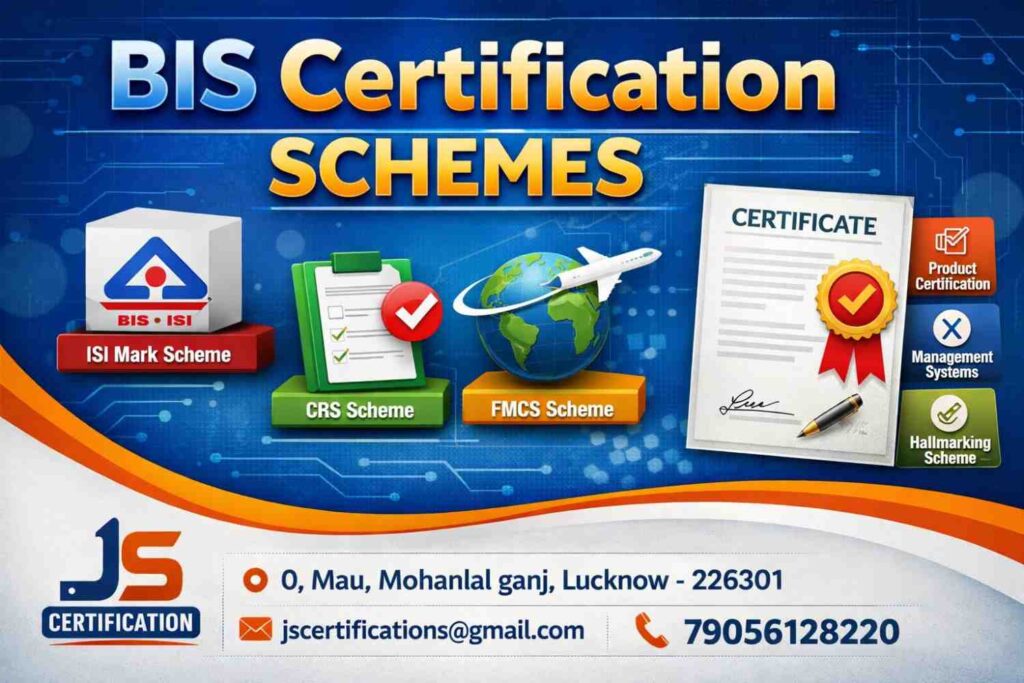
BIS Certification Schemes — All Types Explained
BIS does not follow a one-size-fits-all approach. Depending on the type of product and whether you are a domestic or foreign manufacturer, BIS has designed separate certification schemes. Here is a complete breakdown:
1. ISI Mark Scheme (Domestic Manufacturer Certification Scheme)
This is the most common and widely recognised BIS certification scheme in India. Under this scheme, an Indian manufacturer applies to BIS to get a license to put the ISI Mark on their product.
The ISI Mark on a product means it conforms to the applicable Indian Standard (IS). For example, a pressure cooker with the ISI Mark means it has been tested against IS 2347 standards.
Key Facts:
- Applicable to domestic (Indian) manufacturers only
- Covers around 380 mandatory product categories
- Voluntary for non-mandatory products but boosts consumer trust
- Requires factory inspection and product testing by BIS
- Governed by Conformity Assessment Scheme – I (Schedule II of BIS Regulation 2018)
Common products requiring ISI Mark: Cement, steel, LPG cylinders, electrical switches, helmets, toys, packaged drinking water, etc.
2. Foreign Manufacturer Certification Scheme (FMCS)
If you are a manufacturer based outside India and want to sell your products in the Indian market, you need a BIS certificate under the FMCS scheme. BIS has been running this scheme since 2000 under the BIS Act 2016.
Under FMCS, BIS grants a licence to foreign manufacturers to use the ISI Mark on products that conform to applicable Indian Standards. The Foreign Manufacturer Certification Department (FMCD) is the only authority responsible for issuing these licences.
Important Points:
- Applicable to all product categories EXCEPT electronics and IT goods
- Electronics and IT goods are covered under the CRS scheme
- All foreign manufacturers must appoint an Authorized Indian Representative (AIR) to apply
- The AIR acts as the local point of contact and compliance anchor in India
- Products must be tested in a BIS-recognised lab before the licence is granted
This is one of the most critical BIS certification schemes for importers and global brands wanting to enter India.
3. Compulsory Registration Scheme (CRS) — For Electronics and IT Products
The Compulsory Registration Scheme was introduced in 2012 by the Department of Electronics and Information Technology (MeitY) and BIS to protect Indian consumers from unsafe or sub-standard electronic goods.
Under CRS, before any electronic or IT product can be sold or imported into India, the manufacturer must obtain a BIS registration with a unique R-number (Registration Number). This R-number must be displayed on the product.
Key Points:
- Mandatory for all products notified under the Compulsory Registration Order (CRO)
- Covers approximately 79 to 81 product categories including laptops, LED TVs, mobile phones, power banks, smart meters, etc.
- Based on self-declaration of conformity against applicable Indian Standards
- Testing must be done in a BIS-approved or NABL-accredited lab
- Applicable to both domestic and foreign manufacturers
Unlike the ISI Mark scheme, CRS does not require a factory audit — it is based on product testing and self-declaration. This makes the process slightly faster but equally strict in terms of compliance.
4. BIS Hallmarking Scheme
Gold and silver jewellery in India is covered under the BIS Hallmarking Scheme. BIS introduced Gold Hallmarking in 2000 and Silver Hallmarking in 2005 to protect buyers from impure or adulterated precious metal jewellery.
Hallmarking is the precise determination and official recording of the purity level of precious metals. A hallmarked piece of jewellery carries a BIS logo, purity grade (like 916 for 22-carat gold), and an Assaying and Hallmarking Centre (AHC) number.
- Jewellers must obtain BIS registration to sell hallmarked jewellery
- Registration is location-specific (each shop/premise needs separate registration)
- The Assaying and Hallmarking Centre (AHC) must also be BIS-recognised
- BIS hallmarking is mandatory for gold jewellery in notified cities
For consumers, a BIS hallmark is the most reliable proof of gold or silver purity in India.
5. Eco Mark Scheme
The Eco Mark Scheme is run by BIS for products that are environment-friendly. If a product meets both the quality requirements of the applicable Indian Standard AND specific environmental criteria, it can carry the Eco Mark alongside the ISI Mark.
Products covered include soaps and detergents, paints, batteries, plastic products, textiles, leather goods, food items, electrical and electronic goods, and more.
The Eco Mark signals to consumers that the product is not just safe — it is also produced with minimal environmental impact.
Which Products Need a BIS Certificate in India?
Not every product in India requires a BIS certificate. However, the list is large and covers critical safety-sensitive categories:
| Mandatory ISI Products | CRS Electronics Products | Voluntary BIS Products |
|---|---|---|
| Helmets, Toys, Cables, LPG Cylinders, Cement, Steel, Packaged Drinking Water, Pressure Cookers | LED Lights, Mobile Phones, Laptops, Power Banks, Smart Meters, CCTV Cameras, Set-top Boxes | 738 additional products including consumer goods, industrial equipment, and packaging materials |
BIS Certificate Meaning in Real Life — Why It Matters
A lot of people wonder — what does it actually mean when a product carries a BIS certificate? Here is what it means in practice:
- The product has been independently tested against Indian Standards
- The manufacturing unit has passed a BIS factory audit (for ISI Mark)
- The manufacturer is legally allowed to sell the product in India
- The product must continue to meet standards — BIS conducts random market surveillance
- If the product fails BIS standards after certification, the licence can be suspended or cancelled
For consumers, a BIS-certified product means peace of mind. For manufacturers, it means market access, legal protection, and a competitive edge.
BIS Certification in India — Step-by-Step Process
The process to get BIS certification in India varies depending on the scheme, but the general flow looks like this:
Step 1 — Identify the Applicable Scheme
Determine whether your product requires ISI Mark (domestic), FMCS (foreign), CRS (electronics), Hallmarking, or Eco Mark certification.
Step 2 — Prepare Documents
Common documents include:
- Business registration / company incorporation certificate
- Trademark or brand licence
- Manufacturing process flow chart
- List of testing equipment and machinery
- Product technical specifications and drawings
- Authorization letter (for foreign manufacturers — AIR details)
- Test reports from BIS-approved or NABL-accredited laboratories
Step 3 — Submit Application on BIS Portal
Applications are submitted online via the official BIS portal. Domestic manufacturers can apply directly. Foreign manufacturers must apply through their appointed AIR.
Step 4 — BIS Scrutiny and Factory Audit
BIS officials review the application. For ISI Mark and FMCS schemes, BIS conducts a physical audit of the manufacturing premises.
Step 5 — Product Testing
Product samples are collected during the audit and sent to BIS-approved laboratories for testing against applicable Indian Standards.
Step 6 — Grant of Licence
If the product passes testing and the factory meets requirements, BIS grants the licence. The manufacturer can now legally use the BIS mark on the product.
What Is an Authorized Indian Representative (AIR)?
For foreign manufacturers, the AIR is a crucial part of getting BIS certification in India. All foreign manufacturers must appoint an AIR before applying under the FMCS or CRS scheme.
Who can be the AIR?
- If the foreign manufacturer has a liaison or branch office in India — that office becomes the AIR
- If no office exists but the brand trademark owner is in India — they become the AIR
- In all other cases — a separate Indian entity designated by the manufacturer acts as AIR
The AIR is responsible for ensuring compliance with BIS Act, rules, and all licence conditions on behalf of the foreign manufacturer. Choosing the right AIR is important for smooth certification and ongoing compliance.
Key Benefits of Getting a BIS Certificate
- Legal authorisation to sell in India — mandatory products cannot be sold without it
- Consumer trust and brand credibility — the ISI Mark is one of India's most recognised quality symbols
- Competitive advantage — certified products stand out in the market
- Protection against legal penalties — non-compliance can lead to fines and product bans
- Opens doors for government contracts and large retail distribution
- Reduces risk of product recalls due to quality failures
Cost of BIS Certification — What to Expect
The cost of obtaining a BIS certificate in India includes three main components:
| Cost Type | Details | Note |
|---|---|---|
| Product Testing Charges | Varies by product type, lab, and number of models | Highest cost component for complex products |
| Government / BIS Fees | Application fee, audit fee, marking fee, annual licence fee | Fixed by BIS — subject to change |
| Consultant / Professional Charges | Depends on scope, product complexity, and service provider | Working with experienced consultants saves time and reduces errors |
Common Mistakes to Avoid When Applying for BIS Certification
- Applying under the wrong scheme — e.g., using ISI Mark scheme for an electronics product that needs CRS
- Incorrect or incomplete documentation — missing flow charts, lab reports, or AIR authorisation
- Getting products tested in a lab that is NOT BIS-approved or NABL-accredited
- Not staying updated on new products added to the mandatory certification list
- Delaying licence renewal — BIS licences need to be renewed periodically
These mistakes can lead to rejection, delays, or even legal penalties. This is why many manufacturers — both domestic and foreign — prefer working with experienced certification consultants who know the BIS system inside out.
At JS Certification, we help manufacturers across India and globally navigate BIS certification schemes with end-to-end support — from document preparation to factory audit coordination and final licence issuance.
Voluntary vs Mandatory BIS Certification — What Is the Difference?
- Mandatory BIS Certification: Required by law for specific product categories. You cannot manufacture, import, sell, or distribute these products in India without the BIS licence and standard mark.
- Voluntary BIS Certification: Any manufacturer can apply for BIS certification even if it is not legally required. Around 738 products are eligible for voluntary BIS certification.
The list of mandatory products is growing. With increasing Quality Control Orders (QCOs) being issued by the Government of India, more product categories are being brought under compulsory BIS certification every year.
What Happens If You Sell Products Without a BIS Certificate?
Selling mandatory products without a valid BIS certificate is a serious offence under the BIS Act 2016. Consequences include:
- Seizure and confiscation of goods
- Heavy financial penalties
- Criminal prosecution of the manufacturer or importer
- Import clearance denied at Indian customs ports
- Brand and reputational damage
The stakes are high. Getting your BIS certificate on time is not just good practice — it is a legal necessity.
Conclusion — Getting Your BIS Certificate the Right Way
BIS certification in India is a well-structured regulatory framework designed to protect consumers and raise the quality bar for products sold in the country. Whether you are a domestic manufacturer applying for an ISI Mark or a foreign company seeking FMCS certification, understanding the right scheme and following the process correctly is key to a smooth and timely approval.
The BIS certificate meaning is simple: your product is quality-tested, standards-compliant, and legally approved for the Indian market. That assurance is invaluable — for your business and for your customers.
If you are planning to apply for BIS certification and need reliable guidance, JS Certification offers expert consultation for all BIS certification schemes. Our team handles everything — from selecting the right scheme and documentation to lab coordination and liaison with BIS authorities — so you can focus on your business while we handle the compliance.
Get in touch with JS Certification today to start your BIS certification journey with confidence.