
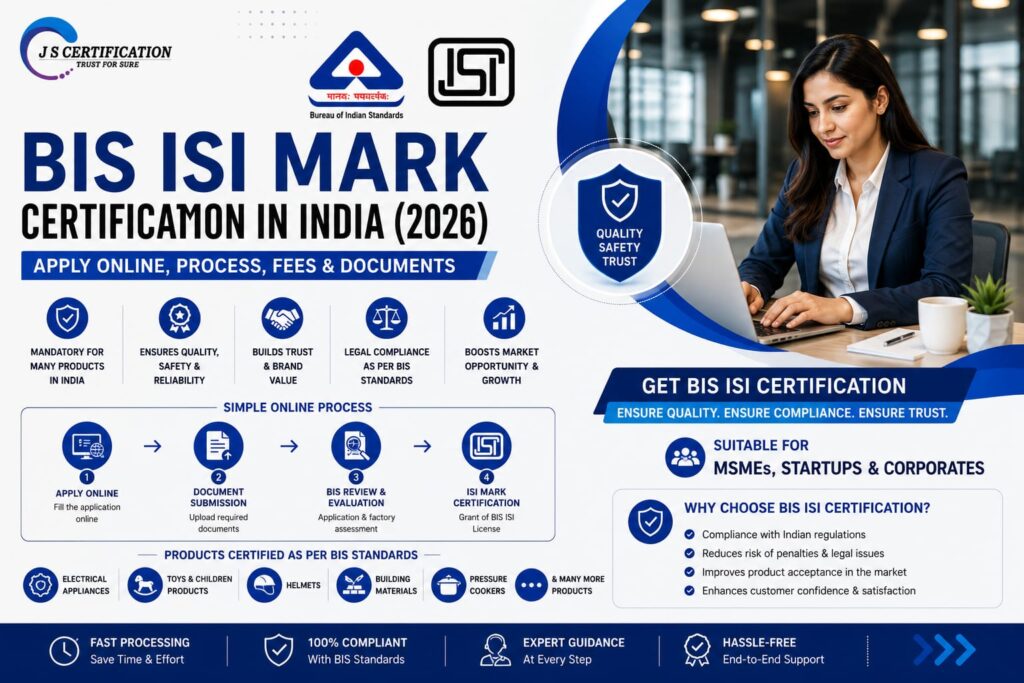
BIS ISI Mark Certification is an official quality approval given by the Bureau of Indian Standards (BIS) to products that meet the required Indian safety and quality standards. The ISI mark on a product means it has been tested in a BIS-approved lab and the manufacturing unit has been inspected by BIS officials. For many product categories in India — such as cement, helmets, gas stoves, electrical wires, and packaged drinking water — the ISI mark is not optional. It is a legal requirement under Quality Control Orders (QCOs) issued by the Government of India. As of 2026, over 150 product categories fall under mandatory ISI certification. The total ISI certification fees typically include an application fee of ₹1,000, a processing fee of ₹2,000, a factory inspection fee of ₹7,000, lab testing charges (which vary by product), and an annual license fee. The complete process takes 35 to 65 days depending on which procedure — simplified or normal — is followed.
Table of Contents
- What is BIS ISI Certification?
- Why is the ISI Mark Important in 2026?
- Products That Need ISI Certification
- ISI Mark Registration Fees – Complete Breakdown
- Documents Required for ISI Certification
- Step-by-Step Process to Apply Online
- Normal Procedure vs Simplified Procedure
- ISI License Cost – What Affects It?
- ISI License Validity and Renewal
- Penalties for Selling Without ISI Mark
- Frequently Asked Questions (FAQs)
What is BIS ISI Certification?
The ISI mark stands for Indian Standards Institute, and it is the most recognized product quality mark in India. It is issued by the Bureau of Indian Standards (BIS), which works under the Ministry of Consumer Affairs, Food & Public Distribution.
When a product carries the ISI mark, it simply means two things:
- The product has been tested in a BIS-recognized laboratory and found to meet the applicable Indian Standard (IS).
- The manufacturing unit has been inspected by BIS officials and found to follow proper quality control practices.
The ISI mark is part of BIS’s Product Certification Scheme (Scheme I), which is one of several certification schemes run by BIS. For most Indian manufacturers, this is the primary route to getting products legally approved for sale in the Indian market.
Why is the ISI Mark Important in 2026?
In 2026, the ISI mark has become more relevant than ever. The Government of India has been expanding the list of products under mandatory Quality Control Orders year after year. Here is why both manufacturers and consumers should care about it:
For Manufacturers and Businesses:
- Selling notified products without an ISI mark can lead to fines, product seizure, and criminal action under the BIS Act, 2016.
- ISI-certified products are preferred by government procurement agencies, large retailers, and e-commerce platforms.
- Certification demonstrates your commitment to quality, which helps build long-term brand credibility.
- ISI certification is often required to participate in government tenders across infrastructure, defence, and public works.
For Consumers:
- The ISI mark helps people identify safe, tested, and reliable products in a crowded market.
- It protects buyers from fake or substandard goods, especially in categories like electrical products, helmets, and packaged water.
Products That Need ISI Certification
The BIS has notified more than 900 Indian Standards for various products. However, only specific products are under mandatory ISI certification as notified by the Government through Quality Control Orders.
Below are the main product categories that require ISI certification:
Electrical and Electronics
- Cables and wires (PVC insulated)
- Ceiling fans and exhaust fans
- LED lamps and CFL bulbs
- Switches and sockets
- Electric meters and transformers
- Household appliances (mixers, geysers, irons)
Building and Construction Materials
- Ordinary Portland Cement (OPC)
- TMT steel bars and mild steel
- Safety glass and float glass
- Ceramic tiles and sanitary fittings
- PVC pipes and fittings
Food and Beverages
- Packaged drinking water (mineral water)
- Edible oils (mustard oil, sunflower oil)
- Dairy products (ghee, butter)
- Fruit juices and packaged snacks
Automobile Components
- Tyres and tubes (for two-wheelers and four-wheelers)
- Automotive batteries
- Brake pads and brake linings
- Helmets (mandatory ISI mark required)
Consumer Goods
- Pressure cookers
- Liquefied Petroleum Gas (LPG) cylinders and valves
- Toys (specific categories)
- Household kitchen utensils
Medical and Health Products
- Syringes and needles
- Blood pressure monitors
- Thermometers
Water and Plumbing
- Water storage tanks
- Water purifiers
- PVC pipes for water supply
ISI Mark Registration Fees – Complete Breakdown (2026)
This is one of the most searched topics — and for good reason. The ISI mark registration fees are not a single flat amount. They are made up of several different charges that apply at different stages of the certification process.
Here is a clear breakdown of all fees involved in ISI certification:
| Fee Type | Amount | When It Is Paid |
|---|---|---|
| Application Fee | ₹1,000 | At the time of application submission on BIS portal |
| Processing Fee | ₹2,000 | During document review and compliance check |
| Factory Inspection Fee | ₹7,000 | Before or during the BIS official factory visit |
| Laboratory Testing Charges | ₹5,000 – ₹1,00,000+ | Depends on product type and number of tests |
| Annual License Fee | ₹1,000 – ₹5,000+ | Paid annually based on product category |
| Marking Fee | Variable | Calculated on production volume and product type |
| Travel/Accommodation of BIS Inspectors | Actual cost | If the factory is in a remote location |
Total ISI Certification Fees – Estimated Range
| Business Size / Product Type | Estimated Total Cost |
|---|---|
| Small manufacturer (low-risk consumer goods) | ₹15,000 – ₹40,000 |
| Medium manufacturer (electrical / plumbing) | ₹40,000 – ₹80,000 |
| Large manufacturer (cement, steel, industrial) | ₹80,000 – ₹2,00,000+ |
These figures are rough estimates. The actual ISI certification fees depend on your specific product, the applicable Indian Standard, and the lab charges for testing.
What Is the ISI License Cost Every Year?
After you receive the initial ISI license, you need to pay a marking fee each year. This fee is calculated based on how much product you manufacture and sell under the ISI mark. BIS specifies marking fee rates in rupees per unit or percentage of production depending on the product category. The annual marking fee can range from a few thousand rupees for small producers to several lakhs for large-volume manufacturers.
At JS Certification, we help manufacturers estimate their total ISI certification fees upfront, so there are no surprises during the process.
Documents Required for ISI Certification
Getting your documents ready in advance saves time and helps avoid rejection. Below is the complete list of documents you will need when applying for ISI certification:
Company and Business Documents
- Certificate of Incorporation (for Pvt Ltd, LLP, Partnership, etc.)
- GST Registration Certificate
- PAN Card of the Company or Proprietor
- Factory License or Factory Registration Certificate
- MSME Registration Certificate (if applicable)
Factory and Premises Documents
- Address proof of the manufacturing unit (rent agreement, lease deed, or NOC)
- Recent utility bills (electricity or water bill of the factory)
- Factory layout plan or site plan
Technical and Product Documents
- Test reports from a BIS-recognized laboratory (confirming compliance with the applicable Indian Standard)
- List of manufacturing equipment with calibration certificates
- Manufacturing process flowchart or step-by-step description
- Raw material details (sources, specifications, supplier information)
- Product drawings or diagrams (showing design, components, dimensions)
- Quality control plan (in-house testing procedures and equipment)
Additional Documents (If Applicable)
- Trademark Registration Certificate (if the product carries a brand name)
- Outsourcing agreement (if any part of manufacturing is done by a third party)
- Previous test reports or approvals from other regulatory bodies
Step-by-Step Process to Apply for ISI Certification Online (2026)
The ISI certification application is submitted through the BIS Manak Online portal at https://manakonline.in. Here is how the process works, step by step:
Step 1 – Identify the Applicable Indian Standard
Before doing anything else, identify the correct IS number (Indian Standard) that applies to your product. For example, IS 1077 for common burnt clay building bricks, or IS 694 for PVC insulated cables. If you are unsure, check the BIS website or contact a consultant.
Step 2 – Get Your Product Tested in a BIS-Recognized Lab
Submit samples of your product to a BIS-recognized testing laboratory. The lab will test the product as per the applicable Indian Standard and issue a formal test report. This test report is mandatory for your application.
Step 3 – Set Up In-House Testing Facilities
BIS requires that manufacturers have some basic in-house quality control equipment to test products during production. Make sure your factory has the required instruments, and get them calibrated if necessary.
Step 4 – Create an Account on BIS Manak Online Portal
Go to https://manakonline.in and register as a manufacturer. Fill in your company details, factory address, and product information.
Step 5 – Fill and Submit the Application
Fill in the online application form under Scheme I (ISI Mark Certification). Upload all required documents, pay the application fee (₹1,000) and processing fee (₹2,000) online, and submit the application.
Step 6 – BIS Factory Inspection
After reviewing your application and documents, BIS will schedule a factory inspection. BIS officials will visit your manufacturing unit to check your equipment, quality control processes, and production records. They will also collect sealed product samples for independent testing.
Step 7 – Independent Lab Testing
The sealed samples collected during the factory visit are sent to a BIS-approved laboratory for testing. This is separate from the test report you submitted during the application.
Step 8 – Grant of ISI License
If the test results are satisfactory and the factory inspection report is positive, BIS grants the ISI mark license. You will receive a license number and authorization to use the ISI mark on your products.
How Long Does It Take?
| Procedure Type | Approximate Timeline |
|---|---|
| Simplified Procedure | 35 to 40 days |
| Normal Procedure | 60 to 65 days |
Normal Procedure vs Simplified Procedure – What Is the Difference?
BIS offers two routes to obtain ISI certification. Knowing which one applies to your situation can save you time and money.
Normal Procedure
This is the standard route for most manufacturers applying for ISI certification for the first time. Under this procedure:
- BIS officials visit the factory before granting the license.
- Product samples are taken during the inspection and sent to a BIS-approved lab.
- The full process takes around 60 to 65 days.
- It is more detailed and thorough, which is why it takes longer.
Simplified Procedure
This is a faster route available for manufacturers who already have test reports from BIS-recognized labs at the time of application. Under this procedure:
- The applicant submits test reports along with the application.
- BIS reviews the documents and test reports first.
- A factory inspection still takes place, but the process moves faster because testing is partly done in advance.
- Approval typically takes 35 to 40 days.
ISI License Cost – What Affects the Total Amount?
Many manufacturers ask: “What will be the total ISI license cost for my product?” The honest answer is that it varies. Here are the main factors that determine the total cost:
Product Category and Type
Different products have different testing requirements. A simple kitchen utensil may need just two or three tests, while an electrical appliance may need ten or more. More tests mean higher lab charges, which increases the total ISI certification cost.
Scale of Production
BIS charges a marking fee based on production volume. If you manufacture 10,000 units per month, your marking fee will be higher than a factory producing 1,000 units. This is an ongoing cost that continues every year as long as you hold the license.
Factory Location
If your manufacturing unit is located far from the nearest BIS office, the travel and accommodation expenses of BIS inspection officials will be added to your bill. This can add a few thousand rupees in some cases.
Number of Product Models or Variants
If you want ISI certification for multiple variants of the same product (for example, different sizes of PVC pipes), each variant may need separate testing. This increases the total cost.
In-House Testing Readiness
If your factory does not have the required in-house testing equipment, you will need to purchase or rent it before the BIS inspection. This is not a fee paid to BIS, but it is still a real cost that affects your total budget.
ISI License Validity and Renewal
Once you receive your ISI license, it does not last forever. Here are the key points to know:
- The ISI mark license is generally valid for 1 year from the date of grant.
- Some product categories may have different validity periods as specified in the relevant Indian Standard.
- You must apply for renewal before the expiry date to avoid a lapse in certification.
- A lapsed license means you can no longer legally use the ISI mark on your products until renewal is approved.
- Renewal involves paying the applicable fees and may include a fresh factory inspection or surveillance visit by BIS.
Surveillance Checks During the License Period: Even after getting the ISI license, BIS conducts periodic surprise inspections and market sample testing to ensure that manufacturers continue to maintain product quality. If a product fails a market test, BIS can suspend or cancel the license and take legal action.
Penalties for Selling Without the ISI Mark
This is something many small manufacturers overlook. If your product falls under the mandatory ISI certification list and you sell it without the mark, the consequences can be serious.
Under the BIS Act, 2016, the penalties include:
- First offence: Imprisonment of up to 2 years and/or a fine of up to ₹2 lakh.
- Repeat offence: Imprisonment of up to 5 years and/or a fine of up to ₹5 lakh.
- Authorities can also order product seizure and destruction.
- E-commerce platforms are also liable if they knowingly list or sell products that require ISI marks without them.
Using a fake or unauthorized ISI mark is a separate and more serious offence under the same Act.
ISI Certification for Packaged Drinking Water – A Special Case
Packaged drinking water (mineral water) is one of the products where the ISI mark is strictly enforced. This is because it directly affects public health. Here is what makes it different:
- The applicable standard is IS 14543 for packaged drinking water.
- BIS conducts more frequent surprise inspections for water products.
- Testing involves microbiological, chemical, and physical parameters, making lab costs higher.
- Any water brand found selling without a valid ISI mark faces immediate product recall and legal action.
If you are in the packaged water business or planning to enter it, ISI certification is the very first compliance step you need to complete.
Common Mistakes to Avoid During ISI Certification
Many manufacturers face delays or rejections due to avoidable errors. Here are the most common mistakes:
- Applying with outdated test reports Test reports must be recent (usually not older than 90 days at the time of application for most products). Using old reports is a common cause of rejection.
- Wrong IS number Selecting the wrong Indian Standard for your product leads to incorrect testing and application rejection. Always confirm the applicable IS number before applying.
- Missing documents Even one missing document (like a calibration certificate for testing equipment) can put your application on hold. Prepare a checklist and double-check before submitting.
- Factory not ready for inspection Some manufacturers apply before their factory is fully set up with in-house testing equipment. BIS inspectors are strict about this. Make sure your quality control setup is complete before the inspection date.
- Not tracking application status After submission, you need to regularly check the BIS Manak Online portal for any queries or deficiency notices from BIS. Ignoring these can cause further delays.
Frequently Asked Questions (FAQs)
The ISI mark is a quality certification mark issued by the Bureau of Indian Standards (BIS) to products that meet the applicable Indian Standard. It confirms that the product has been tested and the factory has been inspected.
No, ISI certification is mandatory only for products notified under Quality Control Orders (QCOs) by the Government of India. As of 2026, over 150 product categories are covered. For other products, it is voluntary but recommended.
The ISI mark registration fees include an application fee of ₹1,000, a processing fee of ₹2,000, a factory inspection fee of ₹7,000, and lab testing charges that vary from ₹5,000 to over ₹1 lakh depending on the product. There is also an annual marking fee based on production volume.
You can apply on the BIS Manak Online portal at https://manakonline.in. Register as a manufacturer, fill in the application form under Scheme I, upload the required documents, pay the fees, and submit. BIS will then schedule a factory inspection and testing.
Under the simplified procedure (where you already have lab test reports), approval takes 35 to 40 days. Under the normal procedure, it takes 60 to 65 days from the date of application.
No. Each manufacturing location requires a separate ISI license, even if the same product is made at both places. You need to submit separate applications for each factory.
BIS (Bureau of Indian Standards) is the government body that sets product standards and grants certifications. The ISI mark is the actual certification mark placed on products that have been approved under BIS's Product Certification Scheme.
If the product fails during the lab testing stage, the application is put on hold. You will need to fix the quality issues, submit fresh samples, and restart the testing process. This adds to the overall timeline and cost.
Yes. The ISI license needs to be renewed annually. Renewal involves paying the applicable fees and may also include a fresh factory inspection or surveillance visit by BIS officials.
Under the BIS Act, 2016, selling notified products without a valid ISI mark can result in a fine of up to ₹5 lakh and/or imprisonment of up to 5 years for repeat offences.
Yes. Foreign manufacturers can apply under the Foreign Manufacturers Certification Scheme (FMCS) by appointing an Authorized Indian Representative (AIR) who acts on their behalf during the certification process.
You can verify the ISI license on the official BIS website at www.bis.gov.in using the manufacturer's license number. BIS also provides a license verification portal for consumers and buyers to check certificate status.
Each product model or variant may need separate testing and certification. However, in some cases, if variants share the same design and materials, they may be covered under the same license. This depends on the applicable Indian Standard.
For small manufacturers making low-risk consumer goods, the total ISI certification cost (including application, testing, inspection, and first-year license fees) typically falls in the range of ₹15,000 to ₹40,000. For more complex products, the cost is higher.