
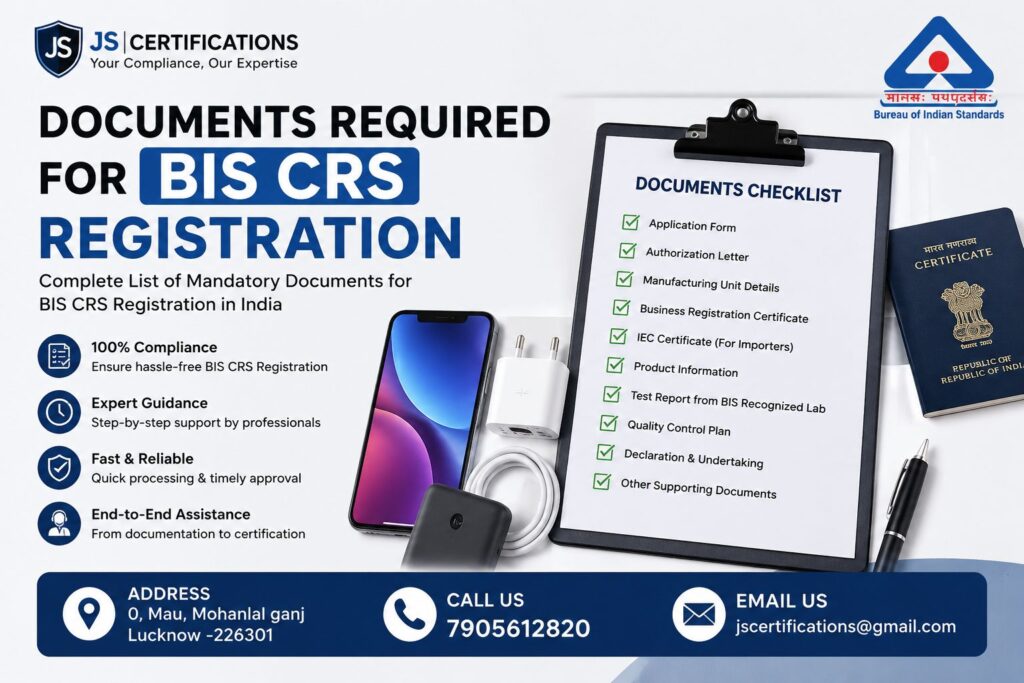
To obtain BIS CRS registration, a manufacturer must submit the following core documents: a valid test report from a BIS-recognized laboratory, company registration proof, PAN card, GST certificate (for Indian manufacturers), brand authorization letter, product details, and the duly filled Form I, Form II, and Form III under the Compulsory Registration Scheme. Foreign manufacturers additionally need to appoint an Authorized Indian Representative (AIR) and submit Form IV along with the AIR’s KYC documents. These BIS CRS certification documents must be submitted through the official BIS online portal at manakonline.in.
Introduction
The Bureau of Indian Standards (BIS) operates the Compulsory Registration Scheme (CRS) under the Electronics and Information Technology Goods (Requirement for Compulsory Registration) Order, which was first introduced by the Ministry of Electronics and Information Technology (MeitY) in 2012. Under this scheme, notified electronic and IT products — including mobile phones, laptops, LED lights, power adapters, set-top boxes, and many more — cannot be manufactured, imported, or sold in India without a valid BIS CRS registration. The BIS CRS registration process is open to both Indian and foreign manufacturers. However, a foreign manufacturer cannot apply directly — they must appoint an Authorized Indian Representative (AIR) who will act on their behalf throughout the registration and post-registration compliance stages.
One of the most common reasons for delays or rejection in BIS CRS registration is incomplete or incorrect documentation. Understanding exactly what documents are needed — and in what format — can significantly speed up your approval and reduce back-and-forth with the BIS portal. This guide covers the complete and updated checklist of BIS CRS certification documents required for a successful application.
Why Documentation Is Critical in the BIS CRS Registration Process
Every document submitted during the BIS CRS registration process serves a specific regulatory purpose. Together, these documents help BIS verify three key things:
First, the legal identity and authenticity of the manufacturer or importer. Second, the technical compliance of the product against the applicable Indian Standard. Third, the accountability of the brand in the Indian market. Missing or mismatched documents at any stage can lead to application rejection, resubmission requests, and unnecessary delays. This is why it is always advisable to prepare your document checklist well in advance before initiating the BIS CRS registration process on the official portal.
Complete Document Checklist for BIS CRS Registration
The required documents can be broadly divided into four categories: documents related to the authorized signatory, business/company documents, technical and testing documents, and additional supporting documents.
1. Documents Related to the Authorized Signatory
The authorized signatory is the individual who signs and submits the BIS CRS application on behalf of the company. The following identity and address documents are required:
A valid government-issued photo identity proof of the authorized signatory is mandatory. Acceptable documents include Aadhaar Card, Passport, Driving License, or Voter ID Card. The name on the identity document must match exactly with the name entered in the BIS online application portal.
A valid address proof of the authorized signatory is also required. This can be a utility bill, bank statement, Aadhaar card, or any other government-accepted address document, and it must not be older than three months at the time of submission.
2. Business and Company Documents
These documents establish the legal standing, tax compliance, and operational legitimacy of the applying entity. Company Registration Certificate or Incorporation Certificate is required to confirm that the business is legally registered in India or abroad. Depending on the type of business entity, this could be a Certificate of Incorporation (for companies), Partnership Deed (for partnership firms), or equivalent legal formation document.
PAN Card of the company or proprietor is mandatory for Indian manufacturers and is used for taxation and financial verification purposes.
GST Registration Certificate is compulsory for all Indian manufacturers and businesses, as it confirms their commercial registration under the Goods and Services Tax regime. Brand or Trademark Registration Certificate is needed if the product is being sold under a registered brand name. This document confirms that the applicant holds legal rights to use the brand in India. A Company Profile or Business Profile document, briefly describing the nature of the business, products manufactured or traded, and operational presence, is often required to support the overall application.
3. Technical and Product Testing Documents
These are the most critical BIS CRS certification documents, as they directly establish whether the product meets the applicable Indian Standard.
Test Report from a BIS-Recognized Laboratory is the most essential technical document. The product must be tested at a laboratory that is officially recognized by BIS for the specific Indian Standard applicable to the product. The test report must clearly mention the product model number, Indian Standard number, test results against each clause, and the lab’s accreditation details. An invalid, expired, or non-BIS-recognized lab test report will result in immediate rejection.
Application Form I is the main application form under the Compulsory Registration Scheme. It captures all relevant information about the manufacturer, product, brand, model, and applicable Indian Standard. This form must be filled out accurately and completely on the BIS online portal.
Declaration under Form II is a self-declaration from the manufacturer confirming that the product conforms to the applicable Indian Standard, that the test report submitted is genuine, and that the product sold in India will continuously meet these standards.
Affidavit under Form III is a notarized legal statement submitted by the manufacturer or the AIR affirming the authenticity of all submitted documents and the accuracy of the information provided in the application.
4. Additional Documents for Foreign Manufacturers
Foreign manufacturers face additional documentation requirements because they must operate in India through an Authorized Indian Representative. The following documents are specifically required for BIS CRS registration documents for importers in India and foreign manufacturers:
Nomination Form IV is the official BIS form through which a foreign manufacturer nominates their Indian representative as the AIR. This is a critical document that establishes the legal authority of the AIR to act on behalf of the foreign company.
An Affidavit from the foreign manufacturer, duly notarized and apostilled (where applicable), is required to confirm the nomination of the AIR and the foreign manufacturer’s commitment to BIS compliance.
KYC Documents of the AIR include the AIR’s identity proof, address proof, and their business registration details. The AIR must be a registered Indian entity or individual.
An Authorization Letter from the foreign manufacturer to the AIR, clearly outlining the scope of authority granted, is also a required supporting document.
5. Other Supporting Documents
Brand Authorization Letter is required in cases where the applicant is not the original brand owner but is manufacturing or importing products under a licensed or contracted brand. The letter must be signed and stamped by the brand owner and clearly authorize the applicant to use the brand name on the product for which CRS registration is being sought.
Factory Details and Manufacturing Address Proof establishes the geographical location of the production unit. For Indian manufacturers, this may include a factory license, electricity bill, or lease agreement. For foreign manufacturers, equivalent location documentation in the home country is acceptable.
Product Label or Packaging Details showing the model number, brand name, product specifications, and country of origin may also be requested during the BIS CRS registration process to verify that the registered product and the market-ready product are consistent.
Key Points to Remember During Document Preparation
All documents in a foreign language must be translated into English and notarized before submission to BIS. Self-attested copies are generally accepted, but original documents may be requested during verification or audits. The test report must be current and typically should not be older than 2 years from the date of registration application. BIS may reject outdated test reports even if the product has not changed.
The Indian Standard number on the test report and the one mentioned in the application must match exactly. Any discrepancy between these two will trigger a rejection or query from the BIS portal.
Every model and variant of a product requires a separate registration. If you have multiple models with the same design and circuitry, it is advisable to consult a professional to understand whether individual test reports are needed or whether a family model approach can be used.
BIS CRS Registration Process: Step-by-Step
Understanding where documentation fits within the larger BIS CRS registration process helps applicants prepare more efficiently.
The first step is product identification — determining whether your product is notified under the Electronics and IT Goods Order and identifying the applicable Indian Standard.
The second step is testing — getting the product tested at a BIS-recognized lab as per the relevant Indian Standard. This is where most of the preparation time is spent. The third step is document preparation — assembling all the documents listed above, including forms, declarations, affidavits, and supporting identity and business proofs.
The fourth step is online application — submitting the application and all documents through the BIS Manak Online portal at manakonline.in, along with the applicable registration fees. The fifth step is BIS review — the BIS reviewing the application, verifying documents, and issuing the registration certificate upon successful verification. If queries are raised, the applicant must respond within the prescribed time.
Common Mistakes to Avoid
Submitting a test report from a non-BIS-recognized laboratory is one of the most frequent and costly mistakes. Always verify the lab’s recognition status on the official BIS website before proceeding with testing.
Providing mismatched model numbers between the test report and the application form is another common error that causes unnecessary delays.
Foreign manufacturers often forget to get the AIR nomination documents notarized and apostilled. Skipping this step leads to document rejection. Uploading poor quality scans or illegible documents also frequently results in queries and resubmission requests. Always upload clear, high-resolution scans of all documents.
Frequently Asked Questions
Only manufacturers can apply — Indian manufacturers directly, and foreign manufacturers through an Authorized Indian Representative. Traders and importers cannot register under CRS independently.
Yes, for all products notified under the Electronics and IT Goods (Requirement for Compulsory Registration) Order, 2012 and its subsequent amendments. Selling or importing such products without CRS registration invites legal action and penalties.
BIS CRS registration is typically valid for 2 years, after which it must be renewed. Products must continue to meet the applicable Indian Standard throughout the validity period.
No. Each distinct model of a product requires a separate BIS CRS registration. However, minor variants may be assessed on a case-by-case basis.
If BIS raises a query or rejects documents, the applicant is given an opportunity to respond and resubmit. Repeated rejections can delay the process significantly, which is why getting documents right the first time is important.