
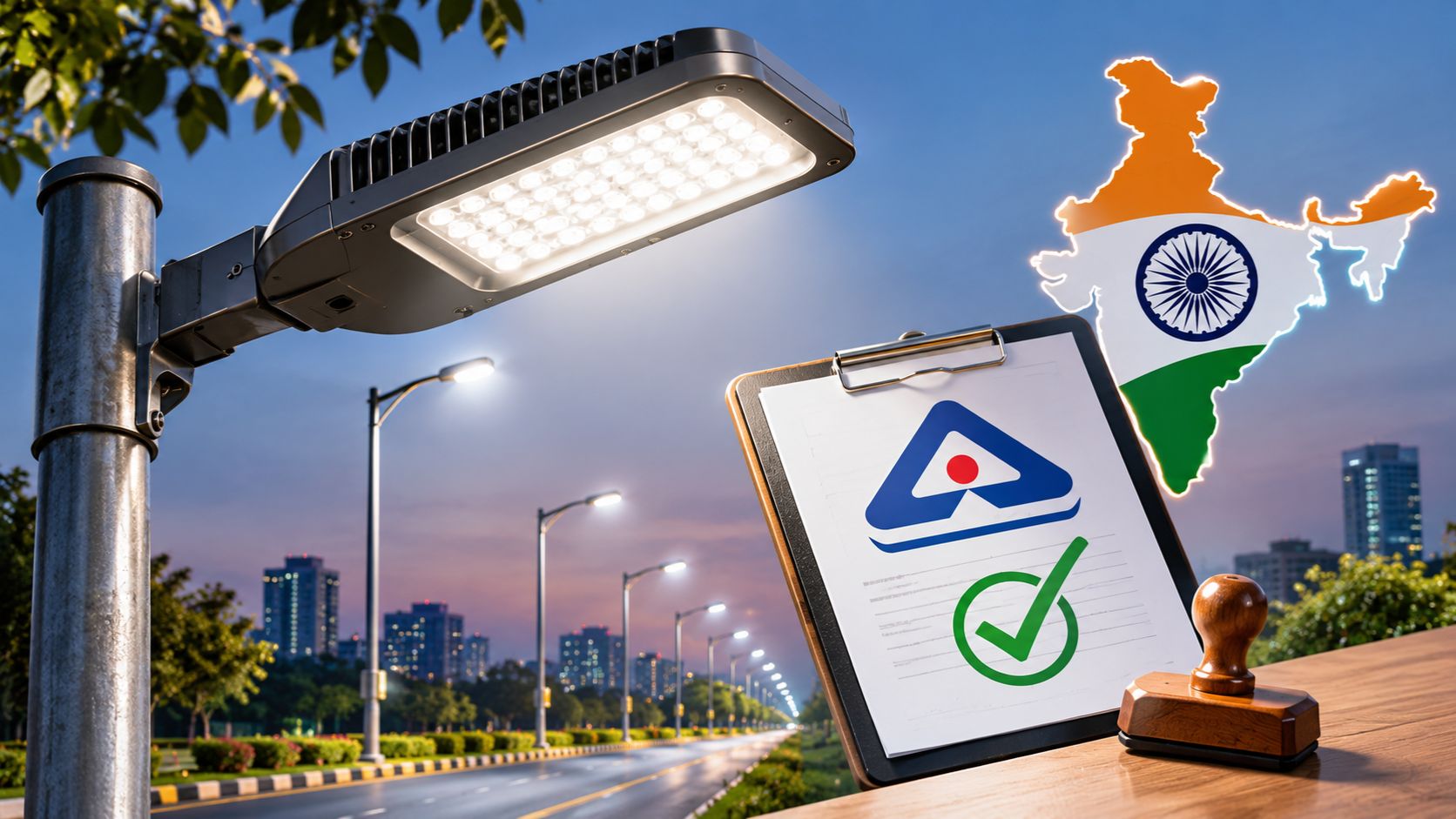
Standards, documents, testing, process, cost and timelines for manufacturers and importers of road and street lighting luminaires.
Quick answer
- Mandatory: yes, under the Compulsory Registration Scheme (CRS), with the Standard Mark and an R-number.
- Standard: test to IS 10322 (Part 5/Sec 3) at a BIS-recognised lab, then apply on the BIS portal.
- Foreign makers: appoint an Authorised Indian Representative (AIR).
- Importers: cannot hold the registration; the manufacturer does.
Manufacturers of LED luminaires, enclosures, connectors, industrial electronics and outdoor equipment are often asked for an IP rating by buyers, tender documents or distributors. The practical question is not only “what is IP65?” but “who tests it, what do they need from me, and will the report be accepted?” This guide answers those in order.
JS Certification is a certification and compliance consultancy. It coordinates product testing through third-party laboratories; it does not operate a laboratory, and the test report is issued by the laboratory that performs the tests.
Not sure which edition of the standard your luminaire should be tested to?
Is BIS CRS Certification Mandatory for LED Street Lights in India?
Yes. LED road and street luminaires have been on the BIS Compulsory Registration Scheme list since 23 May 2018, so every model needs a valid registration and the Standard Mark before sale in India.
LED luminaires for road and street lighting are on the Compulsory Registration Scheme (CRS) product list. The Ministry of Electronics and Information Technology (MeitY) notifies it under the Electronics and IT Goods (Requirement of Compulsory Registration) Order, and BIS runs the registration. A manufacturer cannot sell, import or distribute covered luminaires without a valid registration and the Standard Mark on the product.
CRS is different from the ISI-mark licensing route. Under CRS the product is tested at a BIS-recognised laboratory and registered. BIS does not carry out a factory inspection for the grant. This is Scheme II of Schedule II in the BIS (Conformity Assessment) Regulations, 2018.
What Happens If You Sell or Import LED Street Lights Without BIS?
Penalties apply. Selling or importing CRS-notified goods without registration is an offence under the BIS Act, 2016, with imprisonment, fines and seizure possible.
The Act provides for imprisonment, fines that can run to a multiple of the goods’ value, and seizure of goods on the CRS list sold without registration. Imported consignments without the Standard Mark can be held at the port and may not be cleared. Buyers, including tender authorities, can reject supply and ask for replacement.
Needs confirmation before publishing
The exact penalty amounts and customs procedure should be quoted from the BIS Act, 2016 and current customs instructions by the reviewing expert. They are not stated here as figures.
IS 10322 (Part 5/Sec 3): Standards and the 2026 Transition Guidelines
| Standard | What It Covers | Status |
|---|---|---|
| IS 10322 (Part 5/Sec 3) | Particular requirements for luminaires for road and street lighting (aligned to IEC 60598-2-3) | 2012 edition long in use; 2026 second revision published |
| IS 10322 (Part 1):2026 | General requirements and tests for all luminaires, called up by Sec 3. New items include IPX9, EMF, PELV/SELV, touch voltage and current, battery and EDLC annex, wider photobiological safety and extra marking. | 2026 edition |
BIS issued guidelines on 20 March 2026 for implementing the revised LED luminaire standards. They set a concurrent-running period, during which applicants can register against either the old or the new edition. The guideline gave 2 August 2026 as the end of that period.
Needs confirmation before publishing
Several industry sources, and the IHK Rhein-Neckar chamber in Germany, report that BIS later extended the period to 2 February 2027, citing a corrigendum dated 6 July 2026 and a circular dated 31 July 2026. None of them cites an order number, and we have not found the official notice on the BIS site. Many competitor pages still say the 2 August 2026 date has passed and the new edition is now compulsory. Check the latest notice on crsbis.in, or ask us, before you decide which edition to test against.
Plan for IS 10322 Part 5 Sec 3 compliance to the 2026 edition either way. A report on the older edition may stop being accepted on the end date, and any new design should be tested to the current text. BIS has published a test report format for the 2026 edition of Sec 3 on its website.
Scope of Registration: Covered vs. Excluded LED Luminaires
Covered by Sec 3
LED luminaires for roads, streets, highways, pedestrian areas and similar outdoor public lighting. Mains-powered fixtures with built-in or external LED drivers. This page covers the LED street light standard IS 10322 in detail.
Handled elsewhere
Solar street lights. BIS has no separate category for them. The luminaire is assessed against Sec 3. The battery and solar panel follow their own rules, and panels above 50 Wp can also be subject to MNRE or ALMM requirements and to tender conditions. Confirm the split for your configuration before you book tests.
CRS, ISI Mark or Quality Control Order: Which Route Applies?
LED street lights are registered under CRS and carry the Standard Mark with an R-number. They are not licensed under the ISI-mark scheme and are not governed by a separate Quality Control Order. If a supplier or tender document asks for an “ISI mark”, ask which scheme and standard they mean. The practical test is whether the product is on the CRS list and whether the R-number is valid.
Step-by-Step BIS Registration Process for LED Street Lights
LED street lights are registered under CRS and carry the Standard Mark with an R-number. They are not licensed under the ISI-mark scheme and are not governed by a separate Quality Control Order. If a supplier or tender document asks for an “ISI mark”, ask which scheme and standard they mean. The practical test is whether the product is on the CRS list and whether the R-number is valid.
Match your model to the CRS product list and decide between the 2012 and 2026 editions while concurrent running applies.
Finalise critical components, rating plates and marking. Models are grouped into a series only where BIS rules allow it.
Choose a lab whose scope covers the standard on the BIS lab listing. Submit samples and receive the test report.
Nominate an Authorised Indian Representative before applying.
Create the manufacturer account, fill the application, upload the test report and pay the fees. The report must be no more than 90 days old when you submit.
The hard copy and affidavit follow within 15 days of the online application.
BIS states a normal grant time of 20 working days for a complete application. Mark the product, then keep the annual compliance up to date.
We can check your file against BIS's current checklist before you submit.
Checklist of Documents Required for BIS CRS Registration
BIS updates its checklist from time to time, so confirm against the portal. A typical set looks like this.
Application form and fees payment proof
Test report from a BIS-recognised lab (≤90 days old)
Affidavit and undertaking on the prescribed format
Manufacturer's address proof and contact details
Brand name and trademark details; authorisation if the brand owner differs
Block diagram, circuit diagram, critical components list
Photographs of the product, rating plate and marking
Details of in-house test facilities or equipment
For foreign manufacturers: AIR nomination and supporting documents
MSME proof if claiming the fee concession
Testing at BIS-Recognised Laboratories (LED Street Light Test Scope)
Only a BIS-recognised laboratory with the relevant standard in its scope can issue a report that BIS accepts. BIS publishes lab scopes and indicative test fees on its LIMS site. Fees differ by lab, and some tests are charged separately. Check three things before booking: the scope covers the current edition, the lab has capacity, and the report format matches the BIS format for that edition.
LED road luminaire testing typically covers marking, construction, creepage and clearance, insulation and earth continuity, endurance and thermal tests, ingress protection, photobiological safety and, for the 2026 edition, the new Part 1 items listed above. Failed samples mean retesting, so a pre-compliance check is worth the cost.
Series Formation: Registering Several LED Street Light Models Together
You do not always need a separate test report for every wattage or variant. BIS allows a family of closely related models to be grouped into a series, and a test report on the representative model can cover the rest where the BIS series guidelines allow it. This is the main way to keep testing cost down for a range of street lights.
What qualifies depends on the guideline in force: construction, optics, driver, thermal design and rating differences are all checked. A wrong grouping is rejected, so the series plan should be settled before samples go to the lab. JS Certification maps your model list into the fewest valid series and confirms it against the current guideline.
Needs confirmation before publishing
Quote the series rules from the current BIS guideline document before publishing, since eligibility limits can change.
BIS Certification Cost and Testing Fees for LED Street Lights (2026)
The reported BIS fees are ₹1,000 to apply, ₹50,000 processing (one test report included) and ₹1,000 a year, plus separate lab fees.
Costs have three parts: BIS fees, lab testing and consultancy support. The BIS figures below come from industry sources that cite the current fee schedule. Confirm them on the BIS fee page before quoting a client.
| Item | Amount | Notes |
|---|---|---|
| Application Fee | ₹1,000 | Paid with the application |
| Processing Fee | ₹50,000 | Includes one test report |
| Additional Test Report | ₹20,000 each | For further models or reports |
| Annual Fee | ₹1,000 | Each year of the licence |
| Lab Testing | Varies by lab | BIS listings show examples from about ₹42,900 to ₹55,000 for a base test, with some tests extra |
| Consultancy | Quote on request | Depends on number of models and whether an AIR is needed |
MSMEs may qualify for a fee concession. The licence validity is reported as five years under the amendment of 25 February 2026, with annual fees and production details submitted in advance. Older pages, including some of ours, still say two years. Check the regulation text before relying on either figure.
Your total depends on how many models you register and how many retests you need. Send us the model list and we will give a written quote.
BIS Registration and Government Tenders for LED Street Lights
A valid BIS R-number is more than a legal formality. Tender documents for municipal and public street lighting commonly ask for BIS registration of the luminaire, and procurement portals such as GeM ask suppliers to hold the registrations that apply to the listed product. Without it, a bid can be rejected at the technical stage. Check the tender’s own eligibility clause for the exact certificates it names.
Expected Timeline for BIS CRS Approval
BIS states a normal grant time of 20 working days after a complete application. Lab testing happens first and has no fixed duration.
Testing is the least predictable step because it depends on the lab’s queue and whether the sample passes first time. Missing documents and queries from BIS are what usually stretch the schedule, so plan the file before you test.
BIS Guidelines for Foreign Manufacturers and Importers (FMCS/AIR)
Covered by Sec 3
Registers in its own name through an Authorised Indian Representative. The AIR is the contact for BIS in India. The product is tested at a BIS-recognised lab and shipments carry the Standard Mark and R-number.
Importer or trader
Cannot hold the registration. Buy from a manufacturer that has one, confirm the R-number is valid for the exact model, and check the marking before the goods ship.
Overseas manufacturer? We act as your AIR and manage the BIS file end to end.
How BIS Registration Supports Customs Clearance for Imported LED Lights
For importers, the usual delay is at the port. Customs clearance for LED lights on the CRS list depends on the consignment carrying the Standard Mark and a registration that matches the manufacturer, model and standard. Keep the BIS grant letter, R-number and model list ready with the import documents. A mismatch between the invoice model and the registered model is a common reason for a hold.
BIS grant letter and R-number for the exact manufacturer
Invoice model name matches the registered model name
Manufacturer name and address match the registration
Standard Mark and R-number visible on the product and outer carton
Rating plate details match the registered rating
AIR details on file for foreign manufacturers
Needs confirmation before publishing
Confirm the current customs verification steps for CRS products with a customs expert before giving procedural detail.
Common Rejection Reasons in BIS LED Lighting Applications
- Testing to the wrong edition because a competitor page said the transition had ended.
- Submitting a test report older than 90 days.
- Using a lab whose BIS scope does not cover the standard.
- Changing critical components after testing without telling BIS.
- Marking the product with an R-number before the grant letter arrives.
- Assuming an importer can register on behalf of the overseas factory.
- Treating the solar panel and battery as covered by the luminaire registration.
How to Verify a BIS R-Number for LED Street Lights
Search the R-number on the BIS CRS portal and match the manufacturer, model and standard.
Ask the supplier for the R-number and the model name first. Check that the manufacturer, product and standard match, and that the registration is still valid. A mark on the carton without a matching entry is not proof. Confirm the exact search path on crsbis.in before you publish instructions for it.
Why Choose JS Certification for Your BIS Approval?
JS Certification is a BIS registration consultant in Lucknow serving manufacturers and importers across India. For LED street lights we review your model list against the current standard, plan the test scope, prepare the application, and track queries with BIS until the grant. For overseas manufacturers we also act as the Authorised Indian Representative (AIR).
TO CONFIRM Add verified credentials here: years in practice, number of registrations handled, and the reviewing expert’s name. We have not published numbers we cannot check.
Frequently Asked Questions About IP65 and IP67 Testing
Yes. LED road and street luminaires have been on the Compulsory Registration Scheme (CRS) list since 23 May 2018. Selling, storing or distributing them in India without a valid BIS registration and the Standard Mark is not permitted.
IS 10322 (Part 5/Sec 3), read with the general requirements of IS 10322 (Part 1). A revised 2026 edition exists. BIS's guideline set 2 August 2026 for the transition; industry sources report an extension to 2 February 2027, awaiting official confirmation.
Industry sources report ₹1,000 application, ₹50,000 processing (one test report included) and ₹1,000 annual. Lab fees are charged separately and vary; BIS listings show examples of ₹42,900 to ₹55,000. Verify on the BIS fee page.
BIS states a normal grant time of 20 working days after a complete application. Lab testing comes first, and its duration depends on the lab's queue and on whether your sample passes first time. Ask the lab for a date.
Yes, for the luminaire. BIS has no separate solar street light category, so the LED luminaire is registered under IS 10322 (Part 5/Sec 3). The battery and solar panel follow their own rules, plus MNRE or ALMM requirements where they apply.
No. Registration is issued to the manufacturer, linked to its manufacturing address. A foreign manufacturer applies through an Authorised Indian Representative (AIR). The importer then relies on the manufacturer's valid R-number for customs clearance.
Not for the initial grant. CRS (Scheme II) rests on a test report from a BIS-recognised lab, an affidavit and documents, with no factory audit. BIS can still run market surveillance and sample checks after registration.
It is an offence under the BIS Act, 2016. Penalties include imprisonment, fines that can reach a multiple of the goods' value, and seizure. Imported consignments can also be held at customs.
BIS allows closely related models to be grouped into a series and tested through a representative model. How many models qualify, and what they must share, is set by the current BIS series guideline. Confirm it before planning tests.
Sources report five years under the BIS amendment of 25 February 2026, replacing two years. The manufacturer must pay the annual fee and submit production details in advance each year. Check your grant letter for the validity.