
IS 10322:2026 is the revised Indian Standard series issued by the Bureau of Indian Standards (BIS) governing the safety, construction, and performance requirements of LED luminaires. It replaces the 2012/2013/2014/2017 editions of IS 10322, aligns closer with international IEC 60598 standards, and is mandatory under the Compulsory Registration Order (CRO) for manufacturers and importers selling LED luminaires in India.
What Is IS 10322:2026?
IS 10322:2026 refers to the revised series of Indian Standards covering luminaires — lighting fixtures — issued by the Bureau of Indian Standards. On 20 March 2026, BIS notified the revision of IS 10322 (Part 1), the foundational general-safety standard for luminaires, upgrading it from the 2014 edition to IS 10322 (Part 1):2026. Alongside it, several Part 5 “particular requirements” sections — which cover specific luminaire categories like fixed general-purpose fixtures, recessed luminaires, street lighting, flood lights, hand lamps, lighting chains, and emergency luminaires — were revised in parallel.
These standards fall under the Compulsory Registration Order (CRO), meaning BIS certification for LED luminaires is not optional for products in scope: manufacturing, importing, selling, or distributing a covered luminaire without a valid BIS licence and ISI/CRS registration mark is not permitted in India.
Why the Standard Was Updated
BIS periodically revises Indian Standards to keep pace with technology changes, emerging safety risks, and updates to the corresponding international IEC standards. LED luminaire technology has evolved significantly since the earlier IS 10322 editions were published between 2012 and 2017 — driving factors behind the 2026 revision include closer alignment with current IEC 60598 editions, new luminaire categories and use-cases (such as battery/EDLC-operated and controllable-control-gear luminaires) that the older standards did not clearly address, and a need to tighten electrical shock protection, EMF exposure, and photobiological safety requirements.
Scope of IS 10322 Part 5 Section 1
IS 10322 Part 5 Section 1 — formally IS 10322 (Part 5/Sec 1):2026 — is the particular-requirements standard for Fixed General Purpose LED Luminaires. It replaces IS 10322 (Part 5/Sec 1):2012 and corresponds to IEC 60598-2-1:2020. This section applies to fixed lighting fixtures intended for general illumination in residential, commercial, and industrial settings — ceiling lights, wall-mounted fixtures, downlights, and similar fixed-mount luminaires with integrated control gear. Fancy lights are also captured within this category’s compliance scope under the same notification.
Applicability to LED Luminaires
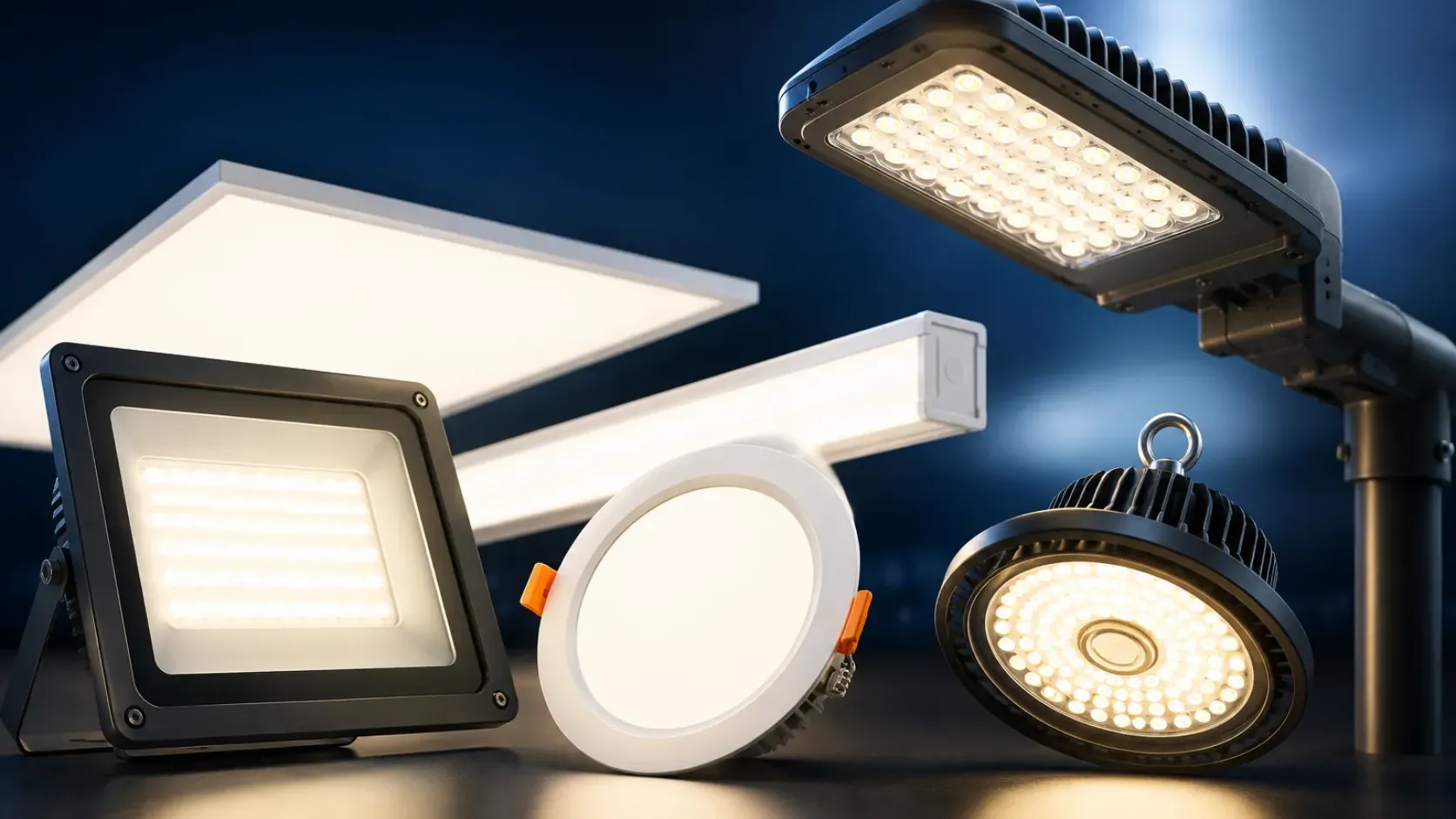
The revised IS 10322:2026 series applies broadly across LED lighting product categories. The table below summarises which Part 5 section applies to which product type, and the corresponding IEC reference each section aligns with.
| Product Category | Old Standard | Revised Standard (2026) | Corresponding IEC Standard |
|---|---|---|---|
| Fixed General Purpose LED Luminaires | IS 10322 (Part 5/Sec 1):2012 | IS 10322 (Part 5/Sec 1):2026 | IEC 60598-2-1:2020 |
| Recessed LED Luminaires | IS 10322 (Part 5/Sec 2):2012 | IS 10322 (Part 5/Sec 2):2026 | IEC 60598-2-2:2023 |
| LED Luminaires for Road & Street Lighting | IS 10322 (Part 5/Sec 3):2012 | IS 10322 (Part 5/Sec 3):2026 | IEC 60598-2-3:2002 + Amd 1:2011 |
| LED Flood Lights | IS 10322 (Part 5/Sec 5):2013 | IS 10322 (Part 5/Sec 5):2026 | IEC 60598-2-5:2015 |
| LED Hand Lamps | IS 10322 (Part 5/Sec 6):2013 | IS 10322 (Part 5/Sec 6):2026 | IEC 60598-2-8:2013 |
| LED Lighting Chains | IS 10322 (Part 5/Sec 7):2017 | IS 10322 (Part 5/Sec 7):2026 | IEC 60598-2-20:2022 |
| LED Luminaires for Emergency Lighting | IS 10322 (Part 5/Sec 8):2013 | IS 10322 (Part 5/Sec 8):2026 | IEC 60598-2-22:2022 |
Key Technical Requirements
The technical changes introduced in IS 10322 (Part 1):2026 apply as a common baseline across all seven Part 5 sections. The most significant additions, per BIS’s own implementation guidelines, include:
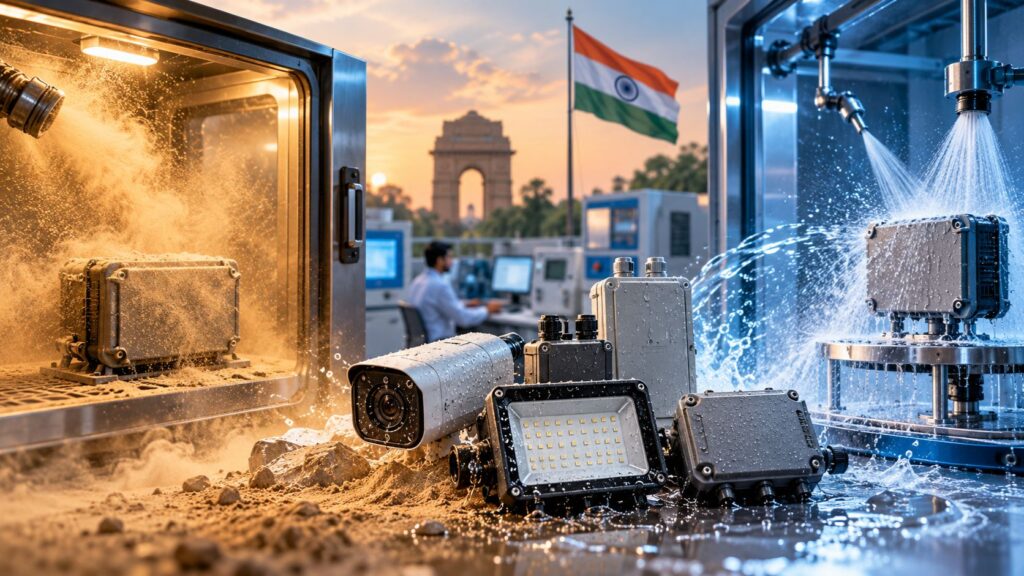
- IPX9 ingress protection introduced for enhanced water-resistance testing.
- Electromagnetic Field (EMF) safety requirements added for the first time.
- Modified marking requirements, including a new sub-clause for marking of mains socket outlets (moved from the information-requirements section).
- A new clause on protection against fast-rotating parts (e.g., moving fan blades in luminaires with integrated cooling).
- Introduction of the PELV (Protective Extra-Low-Voltage) system as a recognised protection method.
- Additional requirements for luminaires using controllable control gear providing SELV output(s).
- Modified testing for whether a conductive part can cause electric shock, including new touch voltage and touch current limits.
- A new informative annexure on power sourcing equipment powering Class III luminaires via IT communication cabling (relevant to PoE-powered lighting).
- A new informative annexure for luminaires requiring a higher degree of availability (impulse withstand overvoltage category III).
- A new normative annexure covering battery/EDLC-operated luminaires.
- Extended photobiological safety requirements.
Major Changes from IS 10322:2012
Beyond the common Part 1 changes above, IS 10322 (Part 5/Sec 1):2026 — the standard specific to Fixed General Purpose LED Luminaires — carries two additional changes: references to IS 10322 (Part 1) have been updated throughout to point to the 2026 edition, and the scope has been modified in line with Part 1 to include all electric light sources, not only LED sources as narrowly defined in the 2012 text.
IS 10322:2026 vs IS 10322:2012 Comparison
| Aspect | IS 10322 (Part 5/Sec 1):2012 | IS 10322 (Part 5/Sec 1):2026 |
|---|---|---|
| Base standard referenced | IS 10322 (Part 1):2014 (as amended) | IS 10322 (Part 1):2026 |
| Corresponding IEC standard | Earlier IEC 60598-2-1 edition | IEC 60598-2-1:2020 |
| Ingress protection testing | No IPX9 requirement | IPX9 introduced |
| EMF safety | Not addressed | Dedicated EMF safety requirements |
| Electric shock protection testing | Basic touch-current provisions | Explicit touch voltage & touch current limits |
| Battery/EDLC-operated luminaires | Not specifically covered | New normative annexure added |
| Product scope | Narrower LED-source definition | Extended to all electric light sources |
| Photobiological safety | Limited coverage | Extended requirements |
| Concurrent running deadline | N/A | 2 August 2026 (now elapsed) |
Relationship with IEC 60598-2-1:2020
IS 10322 (Part 5/Sec 1):2026 is India’s national adoption of, and alignment with, IEC 60598-2-1:2020 — the international particular-requirements standard for fixed general-purpose luminaires published by the IEC. This alignment is a deliberate part of BIS’s broader strategy of harmonising Indian Standards with current IEC editions, which reduces duplicate testing burden for manufacturers who already hold IEC-based CB Scheme certificates and simplifies compliance for products sold in both Indian and international markets.
| Element | IEC 60598-2-1:2020 | IS 10322 (Part 5/Sec 1):2026 |
|---|---|---|
| Issuing body | International Electrotechnical Commission | Bureau of Indian Standards |
| Legal status in India | Reference standard, not directly enforceable | Mandatory under the CRO |
| Base general standard | IEC 60598-1:2024 | IS 10322 (Part 1):2026 |
| Testing location requirement | Any accredited lab globally | Generally requires a BIS-recognised laboratory |
BIS Certification Process for LED Luminaires
The BIS certification process for LED luminaires under IS 10322:2026 broadly follows the standard Compulsory Registration Scheme (CRS) workflow. Timelines vary by application complexity and are not guaranteed by BIS or any consultant — the sequence below outlines the stages involved rather than a fixed schedule.
1. Product classification
Identify which IS 10322 Part 5 section applies to your specific luminaire type, and confirm whether any exemption (export-only, R&D, or Highly Specialised Equipment) applies.
2. Gap assessment against the applicable standard
Compare your product's existing design and test data against the revised IS 10322:2026 requirements — including the Part 1 baseline changes — to identify what new testing or design changes are needed.
3. Sample submission to a BIS-recognised laboratory
Submit representative samples of the lead model for testing against the revised standard.
4. Testing and test report generation
The lab conducts safety, construction, and performance tests and issues a formal test report referencing IS 10322:2026.
5. Application filing on the BIS CRS portal
File the registration application with product details, technical documentation, and the test report.
6. Documentation and query response
Respond to any clarifications or additional information requests raised by BIS during processing.
7. Factory audit coordination (where applicable)
For certain schemes, BIS or its representatives may assess manufacturing facility readiness and quality control processes.
8. Licence/registration issuancee
Once BIS is satisfied with documentation and testing, the registration or licence is granted, permitting use of the ISI mark or CRS registration number as applicable.
9. Ongoing surveillance and compliance
Maintain compliance through market surveillance samples, periodic renewals, and prompt implementation of any further standard revisions.
Product Testing Requirements
LED luminaire testing and compliance under IS 10322:2026 covers construction, electrical safety, and performance parameters. Typical test areas for fixed general-purpose LED luminaires include:
| Test Category | What It Verifies |
|---|---|
| Insulation resistance & electric strength | Protection against electric shock under normal and fault conditions |
| Touch voltage / touch current | Safe limits on accessible conductive parts (2026 addition) |
| Temperature rise | Thermal safety margins during continuous operation |
| Ingress protection (IP rating incl. IPX9) | Resistance to dust and water ingress |
| Mechanical strength & endurance | Structural integrity under stress and prolonged use |
| Resistance to heat, fire, and tracking | Fire safety of insulating materials |
| EMF safety | Electromagnetic field exposure limits (2026 addition) |
| Photobiological safety | Optical radiation exposure limits from the light source |
| Marking & information requirements | Correct, complete product marking per the revised clauses |
Which Manufacturers and Importers Are Affected?
If your business touches any LED luminaire category listed in the Part 5 table above, the revised standard applies to you, regardless of company size or sales volume. Specifically affected:
- Indian manufacturers currently holding a BIS CRS licence under any of the seven old Part 5 sections.
- Foreign manufacturers / OEMs exporting LED luminaires to India, who must certify through an Authorised Indian Representative (AIR).
- Importers and distributors bringing finished LED luminaires into India for resale.
- Private-label brand owners sourcing luminaires from third-party factories and selling under their own brand.
- EPC contractors and system integrators supplying LED luminaires for Smart City, NHAI, PWD, or municipal projects, who need to confirm their suppliers hold compliant licences.
Documentation Checklist
| Document | Purpose |
|---|---|
| Test report from a BIS-recognised lab (IS 10322:2026 compliant) | Primary technical evidence of conformance |
| Product technical drawings / schematics | Verifies construction against declared design |
| Manufacturing process details | Supports factory compliance assessment |
| Declaration of conformity | Formal manufacturer/importer declaration of standard compliance |
| Undertaking for existing series models (for licensees migrating) | Confirms revised-standard requirements are implemented across the licence scope, not just the lead model |
| Company/factory registration documents | Verifies legal manufacturing/importing entity |
| Product labelling & marking samples | Confirms compliance with updated marking clauses |
| Authorised Indian Representative (AIR) appointment (for foreign manufacturers) | Required where the applicant has no Indian office |
Manufacturer Responsibilities
- Conduct a gap assessment of every model in the licence scope against IS 10322:2026, not only the lead model.
- Submit fresh test reports from a BIS-recognised laboratory for lead models previously tested under the old standard.
- Provide an undertaking confirming the revised standard’s requirements have been implemented across other existing series models in the licence scope.
- Maintain in-house quality control aligned with the revised construction and marking requirements.
- Complete migration before the applicable deadline to avoid licence cancellation or model deletion.
Importer Responsibilities
- Verify that imported LED luminaires carry valid BIS registration against IS 10322:2026 before customs clearance and sale.
- Where the manufacturer is based overseas, ensure an Authorised Indian Representative (AIR) is appointed to handle registration and compliance.
- Confirm that product marking on imported units reflects the updated 2026 marking clauses.
- Track the manufacturer’s migration status for each SKU — an importer’s compliance exposure follows the underlying licence, not just the shipment.
Factory Compliance
Factory readiness for BIS compliance under the revised standard typically involves reviewing production line quality control checkpoints against the updated construction clauses (e.g., PELV/SELV implementation, fast-rotating-parts guarding), verifying that in-house test equipment can support routine checks relevant to the new requirements, and updating internal batch inspection records to reference the 2026 standard. Factory audit expectations vary by certification scheme and are ultimately determined by BIS, not by any single consultant’s checklist.
Common Reasons for Certification Delays
| Cause | Why It Delays Certification |
|---|---|
| Testing against the wrong (outdated) standard version | Report gets rejected, requiring retesting |
| Incomplete technical documentation | Triggers query cycles with BIS |
| Design gaps discovered only at testing stage | Forces late-stage redesign and retesting |
| Laboratory backlog | BIS-recognised labs may have queuing delays during transition periods |
| Missing undertakings for existing series models | Incomplete migration submissions for multi-model licences |
| Inconsistent marking across product variants | Raises compliance queries during review |
Common Compliance Mistakes vs Best Practices
| Common Mistake | Best Practice |
|---|---|
| Assuming the old test report is still valid post-deadline | Verify current standard applicability before every filing |
| Migrating only the lead model, ignoring other series models | Submit the required undertaking covering the full licence scope |
| Treating the deadline as a soft target | Plan gap assessment and testing well ahead of the concurrent-running date |
| Overlooking scope changes (e.g., “all electric light sources”) | Re-check whether previously out-of-scope variants are now covered |
| Relying solely on a supplier’s compliance claim (for importers) | Independently verify BIS registration status against the current standard |
Benefits of BIS Certification
- Legal market access — mandatory for CRO-listed LED luminaires; non-compliance blocks manufacturing, import, and sale in India.
- Consumer safety assurance — verified protection against electrical, mechanical, and fire hazards.
- Reduced recall and liability risk — products tested against current safety benchmarks are less likely to face post-market safety issues.
- Market credibility — the ISI mark and CRS registration are recognised trust signals for retailers, distributors, and institutional buyers.
- Alignment with international practice — closer IEC harmonisation can simplify parallel compliance for export-oriented manufacturers.
Frequently Asked Questions
IS 10322:2026 is the revised Indian Standard series for luminaires issued by BIS, replacing the earlier 2012–2017 editions. It sets updated safety, construction, and performance requirements and is mandatory under the Compulsory Registration Order for LED luminaires sold in India.
Manufacturers, importers, and brand owners dealing in LED luminaire categories listed under the CRO — including fixed general-purpose, recessed, street lighting, flood lights, hand lamps, lighting chains, and emergency luminaires — need valid BIS registration before manufacturing, importing, or selling these products in India.
IS 10322 Part 5 Section 1 is the particular-requirements standard specifically for Fixed General Purpose LED Luminaires. The 2026 edition replaces the 2012 version and corresponds to IEC 60598-2-1:2020.
IS 10322:2026 introduces IPX9 ingress protection, EMF safety requirements, updated touch-voltage/touch-current limits, PELV system recognition, new annexures for battery/EDLC-operated luminaires, and an extended product scope covering all electric light sources — changes not present in the 2012 edition.
Typically required: a compliant test report from a BIS-recognised laboratory, technical drawings, a declaration of conformity, manufacturing process details, product marking samples, and — for existing licensees — an undertaking confirming implementation across all series models in scope.
IS 10322 (Part 5/Sec 1):2026 is India's national standard aligned with IEC 60598-2-1:2020, the international particular-requirements standard for fixed general-purpose luminaires. Alignment reduces duplicate technical divergence but does not replace the need for BIS-specific testing and registration.
Timelines vary based on product complexity, laboratory scheduling, and completeness of documentation. BIS and certification consultants do not guarantee fixed timelines; applicants should plan for testing, documentation, and review cycles well in advance of any compliance deadline.
Per BIS's guidelines, licensees who fail to complete migration by the last date of concurrent running (2 August 2026) may face cancellation of their licence or deletion of the affected model from the licence scope, halting legal sale of that product.
No. Even where IS 10322:2026 aligns closely with IEC 60598-2-1:2020, BIS certification requires testing through a BIS-recognised laboratory and formal registration under the CRS — an international IEC CB certificate alone is not accepted as a substitute.
No. Foreign manufacturers can appoint an Authorised Indian Representative (AIR) — a company or individual registered in India — to manage the BIS registration and compliance process on their behalf.
Why Choose JS Certification for BIS Compliance
JS Certification is a BIS certification consultancy supporting manufacturers and importers across BIS, CRS, ISI Mark, FMCS, and related regulatory compliance schemes. For LED luminaire manufacturers navigating the IS 10322:2026 transition, this typically means help with scheme selection, gap assessment against the revised standard, documentation preparation, coordination with BIS-recognised testing laboratories, and liaison with BIS through application filing and licence issuance. As with any regulatory compliance engagement, outcomes and timelines depend on product-specific factors and BIS’s own processing — no consultant can guarantee approval or a fixed certification date.