
ISI Mark vs CRS vs FMCS: Which BIS Certification Scheme Does Your Product Need?
Your status says Objected and an Examination Report is waiting. Here is what the Registrar is asking, how long you have, and how a Section 9 reply differs from a Section 11 reply.
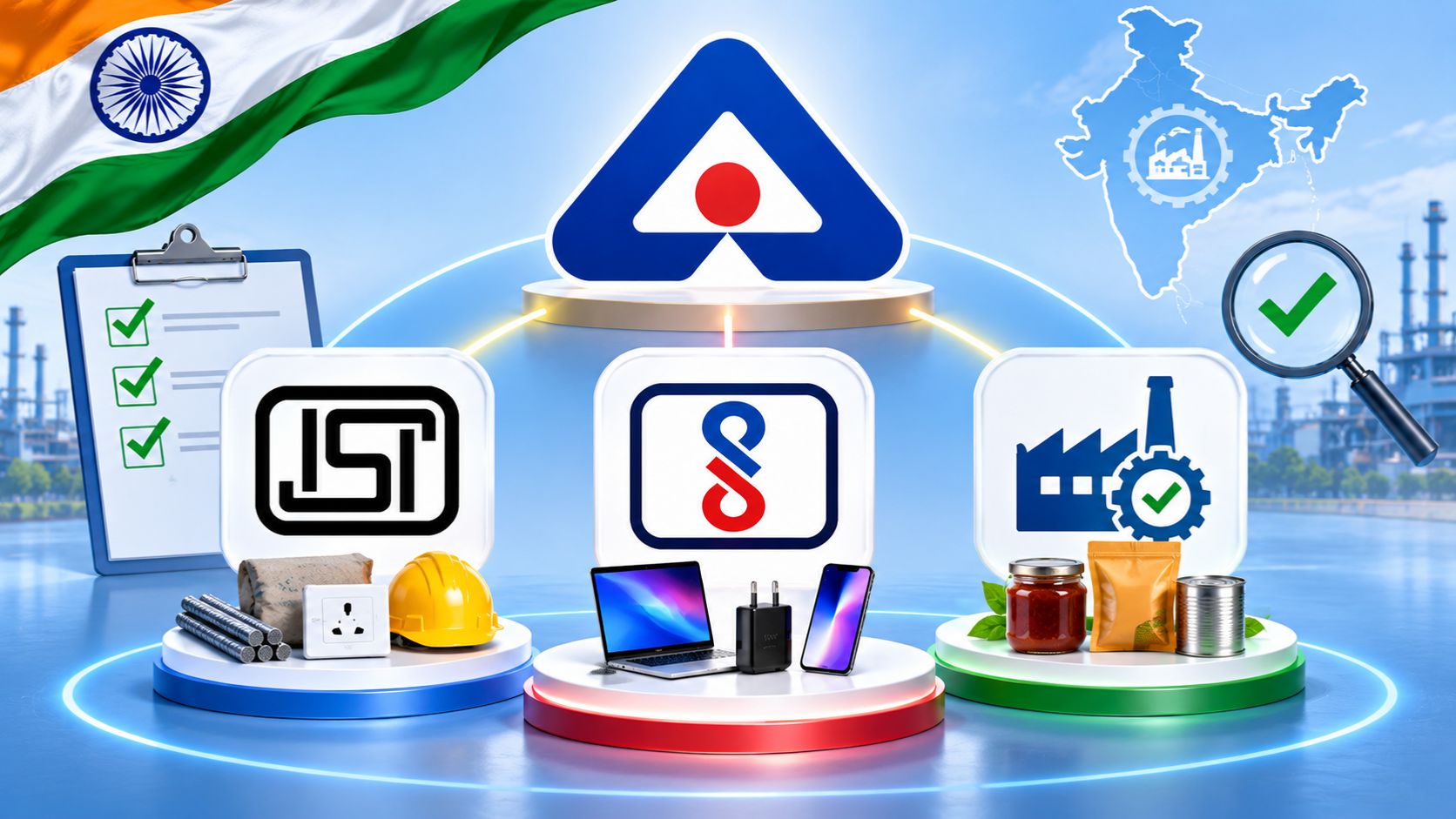
Under the Bureau of Indian Standards Act, 2016, the three primary BIS certification schemes in India are the ISI Mark Scheme (Scheme-I for domestic manufacturers), the Compulsory Registration Scheme or CRS (Scheme-II for notified electronics and IT products), and the Foreign Manufacturers Certification Scheme or FMCS (for overseas manufacturers of non-CRS products).
- Indian factory, non-electronics QCO product: ISI Mark (Scheme-I). Factory inspection plus lab testing. Product carries the ISI Mark with IS number and CM/L licence number.
- Any factory, India or abroad, CRS-notified electronics/IT product: CRS (Scheme-II). Lab testing and self-declaration, no pre-grant factory inspection. Product carries the BIS Standard Mark with an R-number.
- Overseas factory, non-CRS QCO product: FMCS. BIS inspects the overseas factory, an Authorised Indian Representative is mandatory, and the product carries the ISI Mark.
Not sure where your product falls? Tell us your product and get your exact BIS scheme confirmed for free by JS Certification’s BIS specialists.
Overview of primary BIS certification schemes in India (BIS Act, 2016)
BIS runs several conformity assessment schemes, but three decide whether most products can legally be made, imported or sold in India: ISI Mark, CRS and FMCS. All three sit under the Bureau of Indian Standards Act, 2016 and the BIS (Conformity Assessment) Regulations, 2018. The ISI Mark Scheme is Scheme-I and CRS is Scheme-II of Schedule-II of those regulations. FMCS has run since 2000 and is managed by the Foreign Manufacturers Certification Department at BIS headquarters in New Delhi.
Certification becomes compulsory when a ministry notifies your product in a Quality Control Order (QCO) or, for electronics, in the order that places it under compulsory registration. Once that order is in force, nobody may manufacture, import, store for sale or sell the product without the BIS mark. If the words “BIS” and “ISI” still feel interchangeable, our explainer on the difference between BIS and ISI clears that up in five minutes.
Other schemes exist, such as Hallmarking for precious metals, Eco Mark and Scheme-X for certain machinery. They are outside this guide.
What each BIS scheme covers (ISI Mark vs CRS vs FMCS)
1. ISI Mark Certification (Scheme-I: domestic manufacturers)
The ISI Mark Scheme licenses Indian factories to use the ISI Mark after BIS inspects the factory and tests samples against the Indian Standard. It covers products such as cement, steel, cables, electrical accessories, pressure cookers, helmets, toys and many chemicals, where a QCO is in force or where a manufacturer chooses voluntary certification.
- Applied for on BIS’s Manak Online portal (manakonline.gov.in).
- BIS officers inspect the factory, check in-house testing facilities and draw samples for testing in BIS or BIS-recognised labs.
- The licence carries a CM/L number that must appear with the ISI Mark and the IS number on the product.
- Continuing obligations: marking fee, production records, surveillance inspections and market samples.
Fees, documents and the normal versus simplified procedure are covered in our ISI Mark certification process and fees guide.
2. Compulsory Registration Scheme / CRS (Scheme-II: electronics and IT products)
CRS registers manufacturers of notified electronics, IT and certain solar products on the basis of lab test reports and a self-declaration, with no factory inspection before grant. The product list is notified by MeitY (with solar products notified by MNRE) and includes items such as laptops, power adapters, LED lamps and luminaires, displays, power banks and many lithium cells and batteries.
- Applies to Indian and foreign factories alike. Factory location does not change the scheme.
- Samples are tested in a BIS-recognised laboratory in India; the report supports the application.
- The grant gives a registration number (R-number) shown with the BIS Standard Mark.
- A separate registration is needed for each manufacturing location and for each brand made there.
- Foreign manufacturers with no Indian office appoint an Authorised Indian Representative.
For test plans, documents and the most common rejection reasons, read our guide to CRS registration for electronic products.
3. Foreign Manufacturers Certification Scheme / FMCS (overseas non-CRS manufacturers)
FMCS is how a factory outside India obtains an ISI Mark licence for products that are not on the CRS list. BIS says FMCS covers every product with an Indian Standard that is amenable to certification, except the electronics and IT products notified under CRS.
- Only the foreign manufacturer may apply. An importer cannot apply in its own name.
- An Authorised Indian Representative (AIR), resident in India, is mandatory and normally represents only one manufacturing firm.
- BIS officers inspect the overseas factory; samples are tested in BIS or BIS-recognised labs in India at the applicant’s cost.
- One application per product (Indian Standard) per factory location; extra brands from the same location are added by undertaking.
- The licence agreement includes financial undertakings such as a performance bank guarantee; confirm the current amount and format with BIS before budgeting.
- BIS states that the average time to grant is about six months.
The application stages are similar to domestic registration, explained in our step-by-step BIS registration process guide. [Content Opportunity — Do Not Invent Link: dedicated FMCS service page]
ISI Mark vs CRS vs FMCS: complete side-by-side comparison table
The fastest way to see the difference is to compare what each scheme asks of the factory, the product label and the Indian partner.
| Factor | ISI Mark (Scheme-I) | CRS (Scheme-II) | FMCS |
|---|---|---|---|
| Who it is for | Manufacturers with factories in India | Indian and foreign manufacturers of notified electronics, IT and solar products | Manufacturers with factories outside India (non-CRS products) |
| Typical products | Cement, steel, cables, switches, helmets, toys, pressure cookers, chemicals | Laptops, adapters, LED lamps, displays, power banks, lithium cells | Same range as ISI Mark: steel, tyres, toys, appliances, chemicals |
| Factory location | India | India or abroad | Outside India |
| Portal | manakonline.gov.in | crsbis.in (CRS portal) | BIS FMCS (FMCD, BIS HQ New Delhi) |
| Factory inspection before grant | Yes, by BIS officers | No; lab report + self-declaration | Yes, BIS officers visit the overseas factory |
| Testing | BIS or BIS-recognised lab + factory samples | BIS-recognised lab in India | BIS or BIS-recognised lab in India |
| Mark on product | ISI Mark + IS number + CM/L number | BIS Standard Mark + R-number (check latest labelling guideline) | ISI Mark + IS number + licence number |
| Authorised Indian Representative | Not applicable | Required for foreign makers without Indian office | Mandatory |
| Who applies | Manufacturer | Manufacturer (per location, per brand) | Foreign manufacturer only |
| Financial undertaking | Marking fee | Annual fee | Marking fee + performance bank guarantee (confirm current amount with BIS) |
| Typical time to grant | About 1 to 4 months | Several weeks, driven by lab queue | About 6 months (BIS average) |
| Validity (2026 amendment) | Up to 5 years, fee paid annually | Up to 5 years, fee paid annually | Up to 5 years, fee paid annually (verify on licence) |
Timelines are typical ranges and depend on lab queues, document quality and inspection scheduling. Government fees are not listed because BIS revises them; check the current fee schedule on bis.gov.in.
How to decide which BIS scheme applies to your product (2-question decision matrix)
Answer two questions: is the factory in India or outside, and is the product on the CRS list or under a non-electronics QCO? The answers point to exactly one scheme.
| CRS-notified electronics / IT / solar product | Non-electronics product under a QCO | |
|---|---|---|
| Factory in India |
CRS (Scheme-II) Lab test + self-declaration. R-number. |
ISI Mark (Scheme-I) Factory inspection + testing. CM/L number. |
| Factory outside India |
CRS (Scheme-II), not FMCS Same lab route. AIR if no Indian office. |
FMCS BIS inspects overseas factory. AIR mandatory. ISI Mark. |
If your product is on neither list, BIS certification is voluntary for it today. Check other Indian approvals that may still apply, such as WPC for wireless devices, BEE for energy labels or LMPC for packaged goods.
Domestic factory vs overseas factory
Factory location only changes the scheme for non-electronics products. An Indian steel or cement plant uses Scheme-I; a Vietnamese or Chinese plant making the same product uses FMCS. For CRS products, an Indian and a Chinese factory follow the same registration route, and the foreign one adds an AIR.
MeitY electronics/IT goods vs non-electronics QCO products
The product’s order, not its general category, decides the scheme. A product counts as a CRS product only if it appears in the compulsory registration schedule. Many electrical goods, such as switches, cables, room heaters and some appliances, are under ISI Mark QCOs even though they are “electrical”. Always read the order that names your product, and the exact Indian Standard it cites.
Special case for importers and private-label brand owners (AIR and factory licensing rule)
BIS licenses the factory, not the brand and not the importer. If you import white-label goods and sell them under your own name, the overseas factory must hold the CRS registration or FMCS licence, with your brand added to it. Three practical consequences:
- Supplier switch: moving production to a new factory means a new licence or registration for that factory before goods can carry the mark. Plan the switch around BIS lead times.
- Brand coverage: under CRS, each brand at a location needs its own registration. Under FMCS, extra brands from the same location are added by undertaking. Either way, the mark on your goods must match a licence that lists your brand.
- AIR role: the AIR is the factory’s legal contact with BIS and signs its undertakings. An importer related to the manufacturer can be nominated as AIR, but the licence still belongs to the factory.
Add Your Heading Text Here
Share the product name, specification sheet and factory location. JS Certification’s BIS specialists will confirm the Indian Standard, the QCO status and the right scheme before you spend on testing.
Step-by-step: how to check your product's IS standard and mandatory QCO status
Do these four checks before paying any lab, government or consultant fee.
- Describe the product exactly and note its HS code. Use the technical description, ratings and use. An HS code alone can mislead, because one code can cover both notified and non-notified goods.
- Find the applicable Indian Standard (IS number). Search the standard on BIS’s standards portal and confirm the current version. Standards are revised, and an old version on your test report can sink the application.
- Check the active QCO or CRS schedule. Look the product up in BIS’s list of products under compulsory certification and the CRS product list. Read the Gazette notification for the enforcement date, exemptions (such as R&D samples or MSME relaxations) and scope.
- Confirm a BIS-recognised lab can test it. Ask for the test plan, sample quantity and current queue. For FMCS and ISI, also check that the factory has the in-house testing equipment the Indian Standard requires.
Our guide on how to get a BIS certificate walks through the application stages that follow these checks.
Common BIS scheme selection mistakes that block customs clearance or launch
Most rejections and port holds trace back to one of these six errors.
- Filing FMCS for an electronics product. CRS-notified goods go through CRS even from foreign factories.
- Applying in the importer’s name. FMCS applications must come from the manufacturer; CRS registrations are also issued to the manufacturing unit.
- Using a licence from another factory. A licence covers one product at one location. Goods from a second plant are not covered.
- Brand not on the licence. Goods carrying a brand that is not listed against the R-number or CM/L number are non-compliant.
- Wrong marking. Missing IS number or licence number, or a sticker label on CRS products, which BIS labelling guidelines do not allow.
- Letting the licence lapse. Since the 2026 amendment, licences can run up to five years but fees are paid annually in advance. A missed payment can lead to suspension.
Tell us your product — confirm your BIS scheme for free with JS Certification
JS Certification, a BIS consultancy based in Delhi, India, helps domestic manufacturers, importers, brand owners and overseas factories pick the right scheme and get through ISI Mark, CRS and FMCS approvals. Before you book a lab slot, send us your product details. We will tell you, free of charge:
- which Indian Standard applies and whether a QCO or CRS order is in force;
- whether you need ISI Mark, CRS or FMCS, and who must apply;
- what your factory, AIR and labels need before the application.
Get my free scheme confirmation
Explore our full BIS registration and certification services.
Frequently asked questions (ISI Mark, CRS, FMCS and BIS registration)
Under the BIS Act, 2016 and the BIS (Conformity Assessment) Regulations, 2018, the three schemes most manufacturers and importers deal with are the ISI Mark Scheme (Scheme-I, with a factory inspection), the Compulsory Registration Scheme or CRS (Scheme-II, for notified electronics, IT and certain solar products) and the Foreign Manufacturers Certification Scheme or FMCS (the ISI Mark route for factories outside India making non-CRS products).
No. BIS certification is the umbrella term for all conformity assessment by the Bureau of Indian Standards. The ISI Mark is the Standard Mark used under Scheme-I, and FMCS also leads to the ISI Mark. CRS products carry the BIS Standard Mark with a registration number (R-number) instead of a CM/L licence number.
If your product is notified under the Compulsory Registration Scheme (for example IT equipment, adapters, LED products or batteries listed in the order), you apply under CRS, not FMCS. BIS states that FMCS covers products other than the electronics and IT goods notified under CRS. Foreign CRS applicants without an Indian office appoint an Authorised Indian Representative.
No. BIS FMCS FAQs state that the application must be made by the foreign manufacturer only. The importer can support the process, and a related importer can be nominated as the Authorised Indian Representative, but the licence is issued to the manufacturing unit.
You can use ™ to show you claim the mark as a trademark. Don't use ® until the mark is registered.
CRS registration is granted on the basis of test reports from a BIS-recognised laboratory and the manufacturer's self-declaration of conformity, so there is no pre-grant factory inspection as there is under the ISI Mark Scheme and FMCS. BIS can still run surveillance, including testing market samples, after registration.
The factory's. BIS grants licences and registrations to a manufacturing unit at a specific location, not to a trading brand. Your brand is added to that factory's licence or registration with brand authorisation documents. Under CRS, each brand made at the same location needs its own registration. If you change factories, the new factory needs its own licence before your goods can carry the mark.
The BIS (Conformity Assessment) Amendment Regulations, 2026, notified on 25 February 2026 and corrected on 28 April 2026, allow licences to be granted and renewed for up to five years, with fees and production details submitted annually in advance. Missing the annual payment can trigger suspension. Check the validity printed on your own licence and the latest BIS circulars.
Match your exact product description (not just the HS code) to its Indian Standard, then check the BIS list of products under compulsory certification and the CRS product list on the BIS portals. Read the Quality Control Order in the Gazette for its enforcement date, exemptions and scope. Orders are amended often, so check again before production or shipment, or ask JS Certification to confirm it for free.